Harrison & Star · Eisai/Helsinn · AOR pitch · 3 min read
Your doctor prescribed
chemotherapy.
Not nausea.
A competitive AOR pitch that answered Eisai's three hardest questions with one patient idea and one empathy tool.
Clinical UX
Interaction Design
Design Strategy
VR/AR

The brief
Eisai needed an AOR for Akynzeo, a CINV drug with strong clinical data and no patient voice. Three RFP questions, $2.5M scope.
What I made
A patient microsite that turned CINV symptoms into an HCP conversation tool, and an iPad interactive that made a physician feel the delayed phase.
What made it different
Both deliverables came from the same idea: the world itself becomes a trigger. Science-grounded empathy, not patient sentiment.
Role
Creative & UX lead
Platform
Web/iPad · iOS · Tablet-first MVA
Scope
AOR Pitch
Team
Copy/art team
Timeline
4 weeks, 2015
Eisai asked three questions.
A $2.5M AOR pitch with three problems to solve.
Akynzeo is a fixed-combination antiemetic covering both phases of CINV: acute (first 24 hours) and delayed (up to 5 days after treatment). Clinically differentiated. But the brand hadn't found a patient voice, and the category was crowded. Eisai's RFP had three direct questions:
1.
What are the top two issues facing Akynzeo and how can the agency help?
2.
How can the agency bring a patient campaign to life that aids brand growth?
3.
What innovative tactics would accelerate performance?
I built one concept that answered all three. The patient campaign and the innovative HCP tactic were the same idea from two different angles: show what CINV actually costs a patient's daily life, then make a physician feel it.
The patient campaign: turning a symptom into a conversation tool
SickofNausea.com
The campaign line was already sharp. So my task was to give it a mechanism that drove HCP conversations, not just brand awareness.
I designed a patient microsite that opened with an SEM hook, walked patients through a short survey about their CINV experience, and then generated a personalized, printable PDF they could bring to their next appointment. The tool turned a passive patient into an active participant in their own care.
Search
SEM capture
"Feeling nauseous after cisplatin?" ads drive to SickofNausea.com
Survey
Map the experience
Reduced clicks across all high-frequency workflows
Generate
Personal PDF
A branded summary the patient prints and brings to their next HCP visit
Activate
HCP conversation
"Ask your doctor how AKYNZEO may help prevent future CINV."


Why this mechanic mattered
Patients rarely arrive at an oncology appointment with language for the delayed phase. Days 3, 4, 5 after cisplatin pass at home with no clinical contact. The survey gave that experience structure, and the PDF gave it a voice in the exam room. The brand benefit followed naturally.
The innovative tactic: making a physician feel the delayed phase
The world itself becomes the trigger.
For the HCP side, I needed a tactic that did something the detail aid couldn't. Physicians know the 5-day CINV window exists. They don't know what a patient's Tuesday afternoon feels like inside it.
I started with a Japanese research study that reframed everything. Healthy volunteers sat inside a large cylindrical room with alternating black and white vertical stripes painted on the interior walls. The drum rotated. The subjects sat still. Within 15 minutes, 10 of 12 reported nausea, with no pharmacological stimulus. The visual illusion of self-motion was enough.*
Why this mattered clinically
Up to 25% of patients develop anticipatory CINV by their fourth treatment cycle.* The brain learns the clinic, then learns the kitchen, the grocery store, the Tuesday afternoon at home. The nausea lives in the environment. The drum study is the mechanism made visible.

The iPad interactive: Sensitivity and Simulation
Not a description. A proxy.
I built a two-section iPad interactive designed to be left with an oncologist by a sales rep. No narration. No slide deck. The physician picks it up and experiences it.
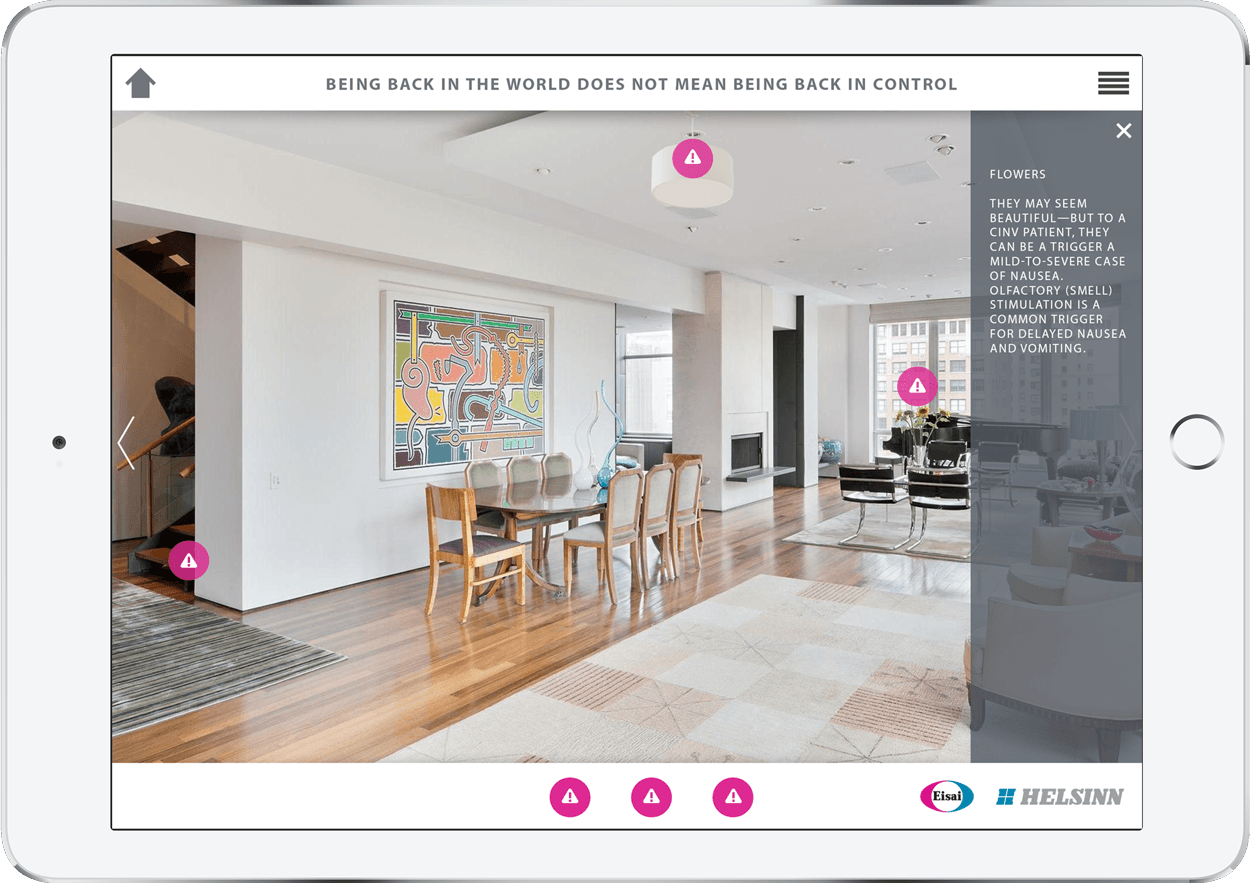
Sensitivity / Everyday objects as conditioned triggers
The kitchen shouldn't be dangerous.
Familiar domestic scenes, a kitchen, a dining table, a grocery aisle, shown inside the iPad. Visually calm on the surface. The discomfort comes from knowing what those images mean to a patient in the delayed phase. Up to 25% develop anticipatory nausea by cycle four.* The brain learns that ordinary environments carry the same signal as the infusion room.

Simulation / The drum, in a physician's hands
Ninety seconds. No explanation needed.
Full-screen alternating black and white stripes inside a Google Daydream VR headset mockup. The same visual stimulus the optokinetic drum study used. A 90-second experience is more effective than any clinical slide on what the delayed phase costs a patient. The rep doesn't have to say a word.


The empathy wasn't intended to be stated. It was supposed to be felt.
The concept scales into a full $2.5M campaign
Five days back.
The campaign line names Akynzeo's delayed-phase coverage window without explaining it. The patient campaign and the HCP tactic are two expressions of the same idea across four surfaces.
Patient digital
SickofNausea.com
SEM-driven microsite. Survey captures CINV experience by day and activity. Auto-generates a personalized PDF for the next HCP visit.
Patient
HCP tool
iPad interactive
Sensitivity and Simulation, left with oncologists. A rep tool that doesn't need a rep to run it.
HCP
Film
What they avoid
Observational short. One patient, one cycle. Shot through the objects they no longer approach. Akynzeo appears once, at the end.
Awareness
Congress activation
The drum, live
A walk-through installation at oncology conferences. Rotating stripe walls, 60 seconds. Exit into delayed-phase outcome data. The contrast does the work.
HCP activation
The empathy came from science, not sentiment
Every decision traced back to something real.
I left Harrison and Star before learning the pitch outcome. What I carried from this project: the optokinetic drum is a documented experiment.1,2 The 25% anticipatory nausea threshold is a real clinical number.3 The striped pattern in the VR headset wasn't decorative. It was the most honest thing I could put in a physician's hands, and the survey tool was the most useful thing I could put in a patient's.
As a sole designer leading both creative strategy and UX execution on a competitive AOR pitch, this is the work I'm most proud of for its coherence: patient tool and HCP tool, two deliverables, one idea.
What I'd pressure-test if I ran it again
The survey assumed patients would engage before their next appointment. I'd want to validate that timing assumption earlier — specifically whether a post-treatment day-two email trigger converts better than an SEM landing. I'd also push the VR entry point harder: the Daydream headset was the right hardware in 2015, but the more interesting question was whether the simulation needed the device at all, or whether a full-bleed iPad experience was enough to land the same empathy without the friction of putting something on your face.
Research references
1.
Imai K, Kitakoji H, Sakita M. "Gastric arrhythmia and nausea of motion sickness induced in healthy Japanese subjects viewing an optokinetic rotating drum." Journal of Physiological Sciences, 56(5):341–345, October 2006. DOI: 10.2170/physiolsci.RP005306. PMID: 17002813. pubmed.ncbi.nlm.nih.gov/17002813
2.
Hain TC. "Optokinetic Nystagmus (OKN) Testing." Dizziness-and-Balance.com, Timothy C. Hain, MD, Northwestern University. Updated December 2025. dizziness-and-balance.com/practice/nystagmus/okn.html
3.
Roscoe JA et al. "The role of patients' expectations in the development of anticipatory nausea related to chemotherapy for cancer." Journal of Pain and Symptom Management, 22(4):843–850, October 2001. Anticipatory nausea reported by approximately 25–30% of patients by the fourth chemotherapy cycle; widely believed to be a Pavlovian conditioned response. See also: ScienceDirect Topics, Anticipatory Nausea and Vomiting. jpsmjournal.com